Quercetin enhances radiosensitivity in T47D breast cancer cells: impact on DNA damage, clonogenic survival, and antioxidant defenses
Keywords:
Radiosensitizer, Breast cancer, Micronucleus, Oxidative stress, RadiotherapyAbstract
Introduction: Radiotherapy resistance remains a significant challenge in breast cancer treatment. Quercetin, a natural flavonoid, has emerged as a potential radiosensitizer. This study examined its effects on hormone receptor-positive T47D breast cancer cells.
Materials and methods: T47D cells were treated with quercetin (20, 40, 60 μM) alone or combined with ionizing radiation (2, 3 Gy). DNA damage (micronucleus assay), clonogenic survival, and antioxidant enzyme activities (SOD, catalase) were evaluated.
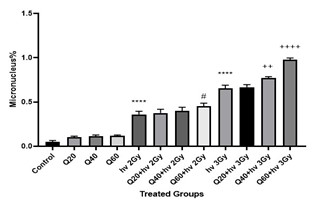
Results: Radiation alone significantly increased micronucleus formation (4.3-9.5 fold vs control, p<0.0001) and reduced clonogenic survival (44-62% reduction vs control, p<0.0001), while decreasing SOD (16-24.5%) and catalase (18-22%) activities (p<0.0001). Quercetin pretreatment enhanced these effects in a dose-dependent manner. The combination of 60 μM quercetin with 3 Gy radiation resulted in: a 10% greater micronucleus formation than radiation alone (p<0.01), further reduction in clonogenic survival to 17% of control values (83% reduction vs radiation alone, p<0.001), and up to 48% greater suppression of antioxidant enzyme activity compared to radiation-only groups (p < 0.01).
Conclusion: Quercetin demonstrates significant radiosensitizing effects in T47D cells through the enhancement of DNA damage and oxidative stress. The substantial reduction in clonogenic survival suggests potential clinical relevance, warranting further investigation in advanced models.
Additional Files
Published
How to Cite
License
Copyright (c) 2026 Mona Haddad Zahmatkesh, Yasna Pourafrasiabi , Hamid Saeidi Saedi

This work is licensed under a Creative Commons Attribution-NonCommercial 4.0 International License.